
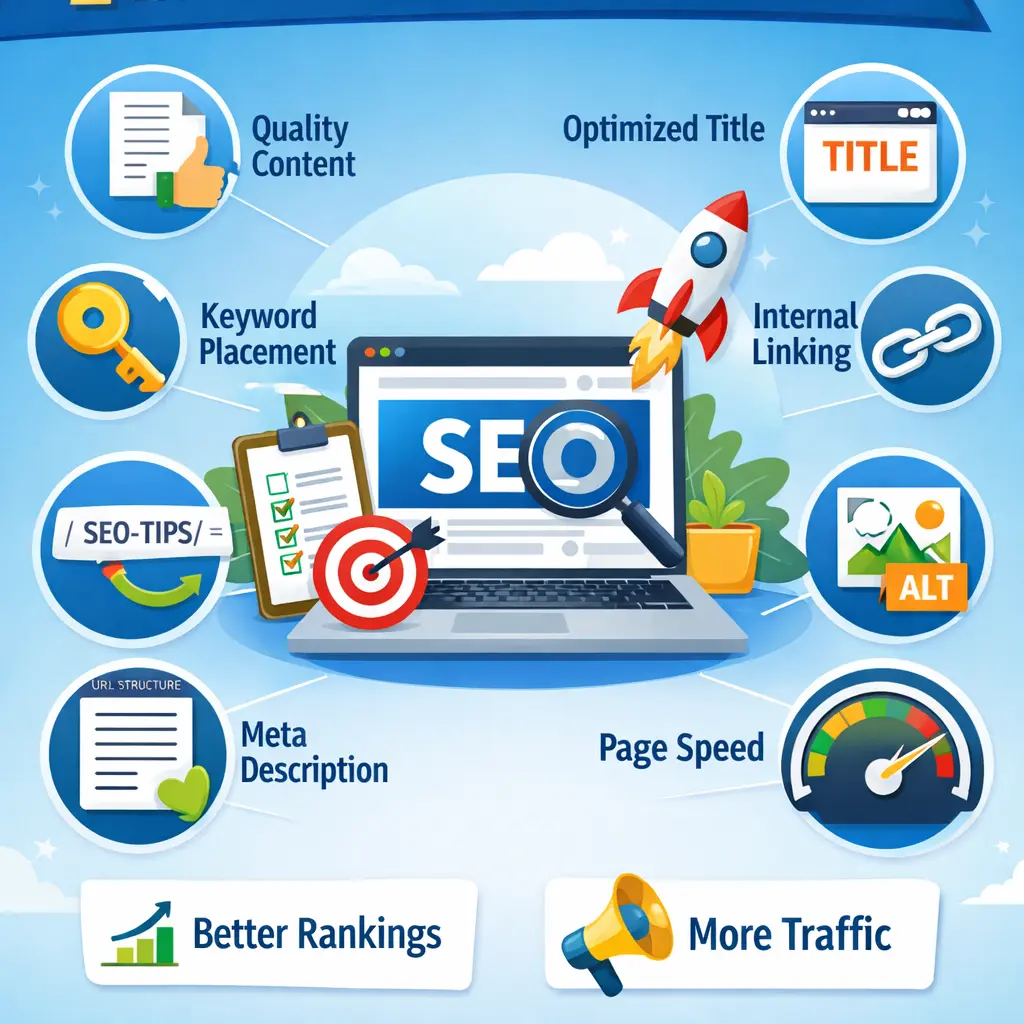
It is quite common for new learners of SEO to get swamped by the countless checklists that most SEO advices provide. This method is a total waste of one’s time.
You should only concentrate on the things that really lead to higher rankings. A limited number of on-page SEO elements will still contribute significantly to ranking in 2026, while all the other factors would be considered as “extras” or “add-ons”. “
Let’s get straight to what works.
1. Content Quality and Depth (Still the #1 Ranking Driver)
Google ranks pages that solve problems better than anyone else.
Write content that:
- Matches search intent clearly
- Covers the topic fully (not surface-level fluff)
- Uses real examples or experience
- Shows credibility (E-E-A-T)
Google’s Helpful Content System rewards content written for humans, not algorithms. If your article exists only to rank, it will struggle.
Simple rule: If a reader leaves satisfied, you did it right.
2. Title Tag Optimization (Your Click Magnet)
Your title decides whether people click or scroll past.
Strong titles:
- Stay under 60 characters
- Place the main keyword early
- Add clarity or curiosity
- Use the current year when relevant
Example:
- Weak: On-Page SEO Guide
- Strong: On-Page SEO Guide (2026): Rank Faster with Proven Steps
A boring title kills traffic—even if you rank #1.
3. Header Tags (Structure That Google Understands)
Headers organize your content. They also help search engines read it faster.
Best practices:
- Use one H1 with your main keyword
- Use H2s for main sections
- Use H3s to break complex sections
- Keep hierarchy clean (don’t jump levels)
Think of headers like a table of contents. If it looks messy, your content feels messy.
4. URL Structure (Short, Clear, Trustworthy)
A clean URL builds trust and improves relevance.
Bad:yoursite.com/p?id=8392
Better:yoursite.com/on-page-seo-guide
Follow these rules:
- Keep it short
- Use your main keyword
- Use hyphens (not underscores)
- Avoid unnecessary words
Users read URLs. Make them readable.
5. Meta Description (Your Free Ad Space)
Meta descriptions don’t directly boost rankings, but they drive clicks.
And clicks influence performance over time.
Write descriptions that:
- Stay under 160 characters
- Include your main keyword
- Add a call-to-action
Example:
Learn the top on-page SEO factors for 2026. Improve rankings and traffic with proven strategies.
Clear beats clever.
6. Keyword Placement (Stop Stuffing, Start Placing)
Keyword density matters less than placement.
Put your keyword in:
- Title tag
- H1
- First 100 words
- One H2
- Meta description
- URL
Then use it naturally across the content.
Aim for readability first. If it sounds forced, fix it.
7. Image Optimization (Easy Wins Most Sites Ignore)
Images can improve engagement—or slow your site down.
Do this:
- Compress images (WebP works best)
- Add descriptive alt text
- Use meaningful file names
- Set width and height
Example alt text:
“on page seo checklist 2026”
Not:
“seo seo best seo tips”
Lazy optimization hurts both UX and rankings.
8. Internal Linking (Your SEO Power Grid)
Internal links help Google understand your site structure.
They also keep users browsing longer.
Best practices:
- Link to relevant pages using descriptive anchor text
- Prioritize important pages
- Use 2–5 internal links per article
Example:
Instead of “click here,” use “on-page SEO checklist.”
Clear anchors improve both SEO and user experience.
9. Page Experience Signals (Speed Matters More Than You Think)
Google tracks how users experience your page.
Key metrics:
- LCP: under 2.5 seconds
- INP: under 200 ms
- CLS: under 0.1
Also:
- Mobile-friendly design
- HTTPS security
- No annoying popups
If your site feels slow, rankings will follow.
10. Schema Markup (Get Rich Results, Not Just Rankings)
Schema helps Google understand your content better.
It can unlock rich results like:
- FAQs
- Reviews (stars)
- How-to steps
You don’t need to code manually. Tools like Yoast SEO or Rank Math handle it.
Schema won’t guarantee rankings, but it improves visibility.
Common On-Page SEO Mistakes
Avoid these:
- Spending hours on formatting but ignoring content quality
- Stuffing keywords into alt text and headings
- Optimizing one page and ignoring the rest
- Ignoring page speed completely
Most SEO problems come from poor priorities.
Pro Tip: Update What Already Works
Don’t start from scratch.
Update your top-performing pages:
- Improve content depth
- Fix titles and meta descriptions
- Add internal links
- Optimize images
Many sites see ranking gains within 30–60 days after updates.
Conclusion
Content quality, title tags, structure, and internal links carry most of the weight.
Master these first. Then refine the rest.
SEO rewards consistency. Apply these factors across your entire site—not just one article—and rankings follow.
FAQs
Which on-page SEO factor matters most?
Content quality. If your content fails, nothing else saves it.
How many factors should I focus on first?
Start with five: content, title, H1, URL, and meta description.
Is schema markup required?
No, but it improves click-through rates and visibility.
How do I track results?
Use Google Search Console. Watch impressions, clicks, and rankings.
Can on-page SEO rank a page alone?
Yes, for low-competition keywords. For competitive niches, you also need backlinks.
